


Man surveys the foothills while hunting with a suppressor mounted on his rifle.
A Hunter’s Guide to Suppressors
For generations, the crack of a rifle shot has been synonymous with fall, hunting season, and hearing damage. But there’s a shift in the hunting world today, and that defining concussive boom is fading. Suppressors, once the choice of assassins and ne’er-do-wells in spy novels and Hollywood, are coming to the woods near you.
You may still be accustomed to calling it a silencer, which is, historically, the official name given by its inventor, Hiram Percy Maxim, more than a century ago. Even Theodore Roosevelt was an early fan of the technology, owning at least three rifles fitted with suppressors. You might also hear it called a can or muffler at the range. Regardless of the name, the modern suppressor is a refined instrument that turns the blast of a high-powered rifle into something more like the “pop” of a .22.
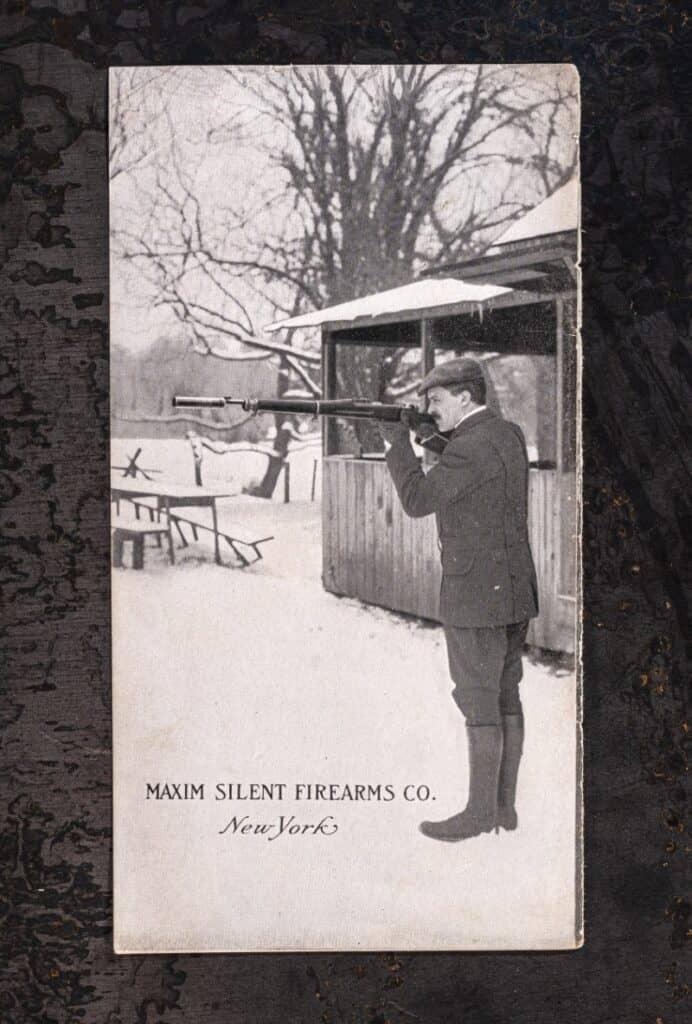
A historic ad for hunting with a suppressor
If you’ve ever thought about trying a suppressor for hunting, there’s more to it than just quieting your shot. You’ll want to know how it can affect your accuracy, what it takes to legally get one, and the rules that come with owning it.
The Unexpected Power of Quiet
The rationale for using a suppressor is not about secrecy; it is about performance, safety, and a commitment to ethical hunting.
The single greatest benefit is how a suppressed rifle affects the person behind the trigger. Every hunter knows the flinch that can come right before popping off a high-powered round. This subconscious psychological response disrupts sight picture and ruins the perfect trigger squeeze. By significantly reducing the noise and redirecting the propellant gases, a suppressor effectively removes this psychological barrier—and some recoil. It allows you to focus solely on the fundamentals of the shot.
This consistency is critical for a well-placed shot. A core principle of fair chase requires a rapid, humane kill, and that demands precise shot placement. A suppressor allows you to practice more comfortably and consistently, dialing in your zero and eliminating the anticipation that leads to poor hits in the field. Quite simply, it’s an ethical tool that dramatically increases your chance of executing the perfect shot.
Then there is the obvious benefit of hearing safety. The noise from an unsuppressed rifle can cause permanent damage, especially when hunting from a blind or within the acoustics of a canyon. While additional hearing protection is still recommended when shooting large magnum calibers, a suppressor effectively reduces the sound intensity below damaging levels for many common rounds. For instance, suppressors can turn down the average boom of a .308 (173 dB) to the level of an unsuppressed .22 (140 dB).
Demystifying the Legal Journey
The complexity of acquiring a suppressor still remains a significant deterrent for first-time buyers, but recent changes and improvements have made the process more accessible than ever. Suppressors are classified as Title II firearms under the National Firearms Act (NFA) of 1934, and the legal process is now faster and more user-friendly due to streamlined ATF electronic forms.
Currently, purchasing a suppressor in 2025 still begins with a mandatory $200 tax stamp; however, Congress has now passed reforms that eliminate this fee starting January 1, 2026. Anyone submitting ATF Form 4 before that date must still pay the tax, but forms submitted after December 31, 2025, will be processed without it. As you might imagine, companies that produce suppressors have websites that walk you through the process. Silencer Central and Silencer Shop are excellent starting points.
To purchase a suppressor, you must initiate the ATF Form 4 submission process through a licensed dealer. This requires a comprehensive package including personal information, fingerprints, and a photograph. After submission, the ATF conducts a background check and begins a waiting period before granting approval and allowing the item to be transferred to your possession. While the process requires patience, it is a straightforward federal compliance requirement. The good news? The wait time to get a suppressor is significantly shorter than it was just a few years ago. If you submit the forms online, the average wait time is around a week. If you submit a paper form, expect to wait up to a year.
Check Your State Regulations
Before you commit to the NFA process, there is a crucial step that some hunters overlook. Don’t assume that if you are federally approved to own a suppressor, you are automatically approved to hunt with it in your state. As of early 2024, it is legal to own a suppressor in 42 states, but only 41 states allow its use for hunting.
While federal compliance is mandatory, state game commissions dictate what equipment is allowed in the field. Therefore, you must confirm both layers of legality. As of this writing, you cannot legally possess a suppressor in California, New York, New Jersey, Massachusetts, Hawaii, Rhode Island, Illinois, or Delaware. Connecticut allows for the federal ownership of a suppressor, but prohibits using them to take game.
Understanding the Trade-Offs
A suppressor is not a magical device; it is a mechanical attachment that changes the dynamics of your rifle. Keep in mind that not every rifle is “suppressor-ready,” meaning you’ll have to take your rifle to a gunsmith to get the end of the barrel threaded so you can screw on a suppressor. There are a few other trade-offs to consider.
First, you are adding bulk and weight. A typical suppressor will add roughly eight inches of length and up to a pound of weight to the muzzle of your rifle. For hunters who carry their rifles for miles or navigate thick brush, this added mass can make the rifle front-heavy, awkward, and prone to snagging. This is why hunters who value mobility often gravitate toward shorter, lighter models constructed from materials like titanium.
Second, the added weight and change in barrel harmonics almost always result in a point-of-impact (POI) shift. This means that once the suppressor is attached, your bullet will strike a different location than your unsuppressed rifle was zeroed for. POI shift is not a sign of poor quality; it’s just the nature of the beast. Because the POI can shift whenever the suppressor is attached or detached, re-zero your rifle every time you use the suppressor for a hunt.
Finally, perhaps the biggest bummer about suppressors is the cost. The average cost of a suppressor ranges from $350 to $1,500, depending on type, materials, and features. Entry-level suppressors typically start around $350–$400, mid-range models (which are the most popular) often fall between $600 and $1,000, and premium or specialty suppressors can reach $1,500 or even more. If you hunt with a $400 rifle and a $200 scope, attaching a can that costs more than the whole setup is a hard pill to swallow.
Even so, if you shoot a lot, value your hearing, or still flinch the moment before you pull the trigger, a suppressor might be something that can help.
PJ DelHomme writes and edits content in western Montana. He runs Crazy Canyon Media and Crazy Canyon Journal.