
Connected Waters: Fishing Madison, Wisconsin’s Yahara Chain
Diverse glacial fisheries and union-led infrastructure projects help sustain the angling tradition in Wisconsin’s capital.
By PJ DelHomme
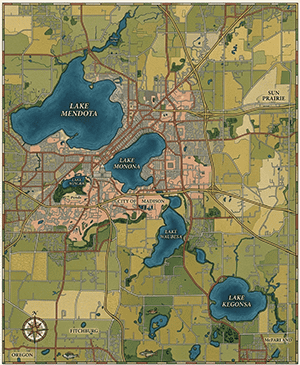
The Mendota, Monona, Wingra, Waubesa and Kegonsa lakes form a 62-mile chain connected by the Yahara River.
There’s beer, cheese, bike trails, the National Mustard Museum, and fishing, oh, the fishing. I’m sure there are some downsides to Madison, but I couldn’t find any worth mentioning. Okay, maybe it has a few mosquitoes because Madison is surrounded by lakes, including Mendota, Monona, and Wingra, with Lake Waubesa and Kegonsa a short drive away. These lakes form a 62-mile chain connected by the Yahara River.
Lake Mendota, the first and largest in the chain, spans more than 9,700 acres and reaches depths of 83 feet. It’s a lake where the summer thermocline dictates where the fish will be. It’s nationally known for its jumbo yellow perch and abundant walleye. Fish here from June to August for walleye and perch, and early fall for smallmouth bass.
For walleye, troll deep-water humps with nightcrawlers or snap-jig hair jigs along steep breaklines. For perch, look for schools in 15-25 feet of water using slip-bobbers tipped with hellgrammites or small minnows. Smallmouth will stack up on deep rock structures and can be caught on drop-shot rigs or Ned rigs.
Lake Monona sits directly across downtown. Fish this lake in spring and fall for peak muskie action. Summer can be good for white bass and largemouth.
Muskie anglers often find success trolling big crankbaits along the weed edges of the Monona Terrace or near the deep drop-offs of the center bar. During the heat of July, watch for the white bass “boils” on the surface during low-light hours and target them with small, flashy casting spoons. Largemouth bass will be tucked into the heaviest milfoil patches and can be pulled out with hollow-body frogs or Texas-rigged soft plastics.
Lake Wingra often serves as an easy access point for the system. See the USA project section below for details. While the larger upper lakes, such as Mendota and Monona, operate on a much larger scale, Wingra’s no-wake regulation offers a quieter, calmer experience. Bring the kids here in the spring for panfish action. Fish here all summer long for bass and muskies.
This is your lake for a family fishing day. A bobber and wax worm fished near the Vilas Park pier is almost a guarantee for bluegill. For adults, targeting the lily pad edges with weedless topwater frogs can produce aggressive largemouth strikes. If you’re hunting muskies, focus on the pockets in the milfoil, using smaller-profile bucktails.
Moving south down the chain, Lake Waubesa has a faster, wilder personality. Covering just over 2,000 acres, it is shallower and more fertile, meaning its fish populations are often denser. Summer is meant for largemouth, while early spring ice-out is good for crappie.
Largemouth bass stack up in the abundant milfoil and lily pads, making punching rigs with heavy tungsten weights and creature baits the most effective way to reach them. Muskie anglers often succeed by targeting the prominent points and deep weedlines using topwater prop-baits to trigger reaction strikes from fish shadowed in the heavy vegetation.
Lake Kegonsa, the “Lake of Many Fishes,” is the final large basin in the chain. Spanning 3,200 acres with a maximum depth of only 32 feet, it is the shallowest of the major Madison lakes and behaves like a giant, productive farm pond. Get the sunscreen and bug dope out in the summer while you fish for walleye and catfish because Kegonsa is a factory for channel cats. During the summer heat, drifting with cut bait (shad or bluegill) across the vast, sandy central flats is highly productive. For walleye, the lake lacks the dramatic structure of Mendota, so success comes from targeting wind-blown flats and sparse rock piles with orange and chartreuse crankbaits to account for the lake’s lower clarity.
Fishing Gear for the Madison Chain of Lakes
Successfully fishing the Madison chain requires a versatile approach, shifting between finesse tactics for panfish and heavy-duty gear for big water predators.
For big water predators like walleye and smallmouth, consider a 6’8” medium-light spinning rod set up with 8-pound braided line and 6-pound fluorocarbon leader. Use 1/8-oz to ¼-oz hair jigs (black or purple) or Ned rigs worked along the deep rock edges in 20 to 30 feet of water.
For the kids on Lake Wingra, you can use a Spider-Man or Elsa Zebco set-up for bluegill and pumpkinseed. Or, if they’re all grown up, any light action spinner with 4-pound line and a bobber works. Toss on a wax worm or a hunk of a nightcrawler and let the squeals commence.
By mid-July, the Madison chain has a little something for every angler, because each lake has its own personality and target species. The hot, humid summer days push the primary game fish off the shallow flats and toward the deep rock bars and weed edges. Whether you choose the deep basins of Mendota, the weedy margins of Waubesa, or the urban shoreline of Wingra, the Yahara chain offers a distinct, high-quality outdoor experience that rivals any location in the Midwest.
Note: Portions of the Yahara Chain are subject to current Wisconsin DNR/DHS fish consumption advisories due to PFAS. Eating guidance varies by species and waterbody, so anglers should review the latest advisory before keeping fish from the system.
Work Boots on the Ground Project
Project: Vilas Park Accessible Fishing Pier
Since Madison is defined by its water, one of the biggest hurdles is often access to that water. Much of the Yahara chain’s shoreline is either private or heavily vegetated, making access difficult for those without a boat. To address this, the Union Sportsmen’s Alliance (USA) partnered with the Building Trades Council of South Central Wisconsin in 2018 to focus on the heart of the Madison urban fishery.
More than 50 union volunteers from local trades donated their skills to transform the dilapidated fishing pier at Henry Vilas Park on Lake Wingra into a fully accessible, ADA-compliant fishing pier.
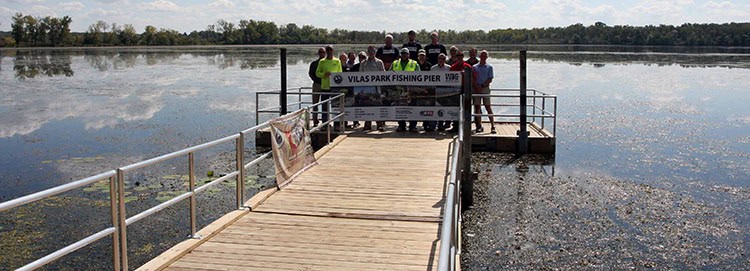
New pier at Vilas Park installed by USA’s union volunteers in 2018.
This pier was strategically positioned over prime panfish habitat, ensuring that the “Take Kids Fishing Day” events—held annually in early June—are a success for the hundreds of local children who participate. By providing free rods, reels, and fishing expertise (like baiting hooks with nightcrawlers) from union members and volunteers, the USA ensures that Madison’s angling tradition is passed to the next generation.
After the 2018 dedication ceremony, Adam Paull of Madison took his four-year-old daughter Natalie fishing on the new pier. Thanks to the abundant and hungry sunfish schooling a short cast from the dock, she quickly reeled in the first fish of her life.
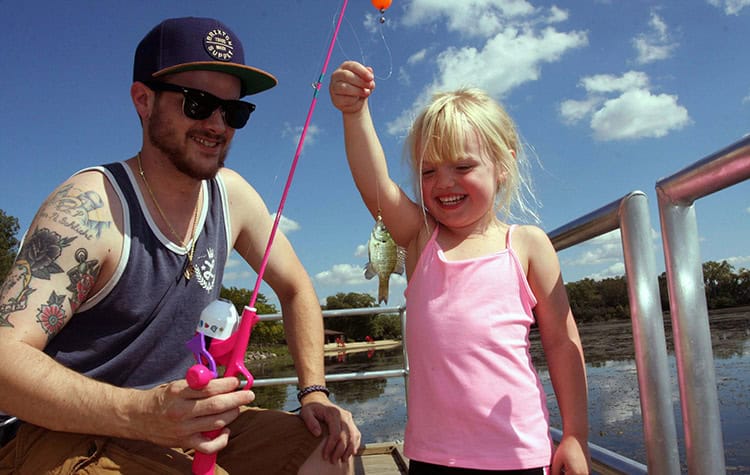
Adam Paull took his four-year-old daughter Natalie fishing on the new pier, and she caught her first fish.
Natalie was ecstatic. “This is great,” Paull said. “The pier is in the perfect place for us to enjoy the lake together and catch fish.”
This article was made possible by USA national partner, Union Plus, a benefits program exclusively for union members (current and retired) and their families