
A Summer Guide to Fishing for Spotted Bass in Georgia’s Lake Allatoona
When the Georgia heat turns the bite vertical, look to the old Etowah riverbed for Allatoona’s nomadic spotted bass.
By PJ DelHomme
Lake Allatoona is carved into the red clay foothills of the Blue Ridge Mountains just 30 miles north of Atlanta. And it’s hardly a secret. This 12,000-acre U.S. Army Corps of Engineers impoundment is one of the most heavily used reservoirs in the country, with millions of visitors annually. It was created in the late 1940s by damming the Etowah River, a project designed for flood control and power that incidentally created a labyrinth of 270 miles of shoreline. Today, it serves as the primary playground for a metro area of over six million people.
On a summer Saturday, the lake can turn into a washing machine of wake boats and jet skis. Fear not. Serious anglers need to worry about what’s underneath the whitecaps. Allatoona is a “low-nutrient” reservoir—what biologists call oligotrophic. The water is often clear, the bottom is notoriously steep, and the cover is sparse. You won’t find endless lily pad fields or sprawling grass beds. Instead, you find a world of flooded timber, rocky bluffs, and the submerged “ghosts” of the Etowah—old roadbeds, bridge pilings, and foundation stones that sit in silence 40 feet down.
In the summer, the water temperature climbs into the mid-80s, and the fishery’s star attraction—the spotted bass, aka ‘spots’—initiates a nomadic summer shift. Unlike largemouths, which might hug a shallow dock regardless of the heat, spots are built for the deep. They school up, patrolling submerged humps, long-tapering points, and the ledges of the old river channel. Identifying these underwater features requires onboard electronics.
This is technical, vertical fishing, which means you aren’t casting to the bank for spots. You’re targeting fish that live in 25 to 45 feet of water. They are aggressive, hard-fighting, and wary. They move fast, shadowing schools of gizzard shad, and if you aren’t dialed into your electronics and your gear, you’re just washing lures. Success here requires a fast tip to feel the subtle “tick” of a deep-water strike and enough backbone to haul a three-pounder out of the timber before it can wrap your line.
Gear Set-up For Lake Allatoona Spots
When the bite goes deep and the pressure is high, the drop-shot is the undisputed tool of choice. It keeps your bait suspended right in the zone while your weight stays pinned to the bottom, providing a natural, hovering presentation that’s hard for spots to ignore. Don’t overlook Ned rigs, finesse worms, and small crankbaits.
Primary Species: Spotted Bass
- Secondary Species: Largemouth Bass & Striped Bass (Hybrids)
- Rod: 7-foot medium, fast-action spinning rod. You need a sensitive tip to telegraph what’s happening 40 feet down.
- Reel: Spinner with a high-quality drag. Spots don’t just pull, they surge.
- Line: 10-pound braided main line tied to a 6-foot leader of 7- or 8-pound fluorocarbon. In the clear summer water, invisibility is mandatory.
- Lures:
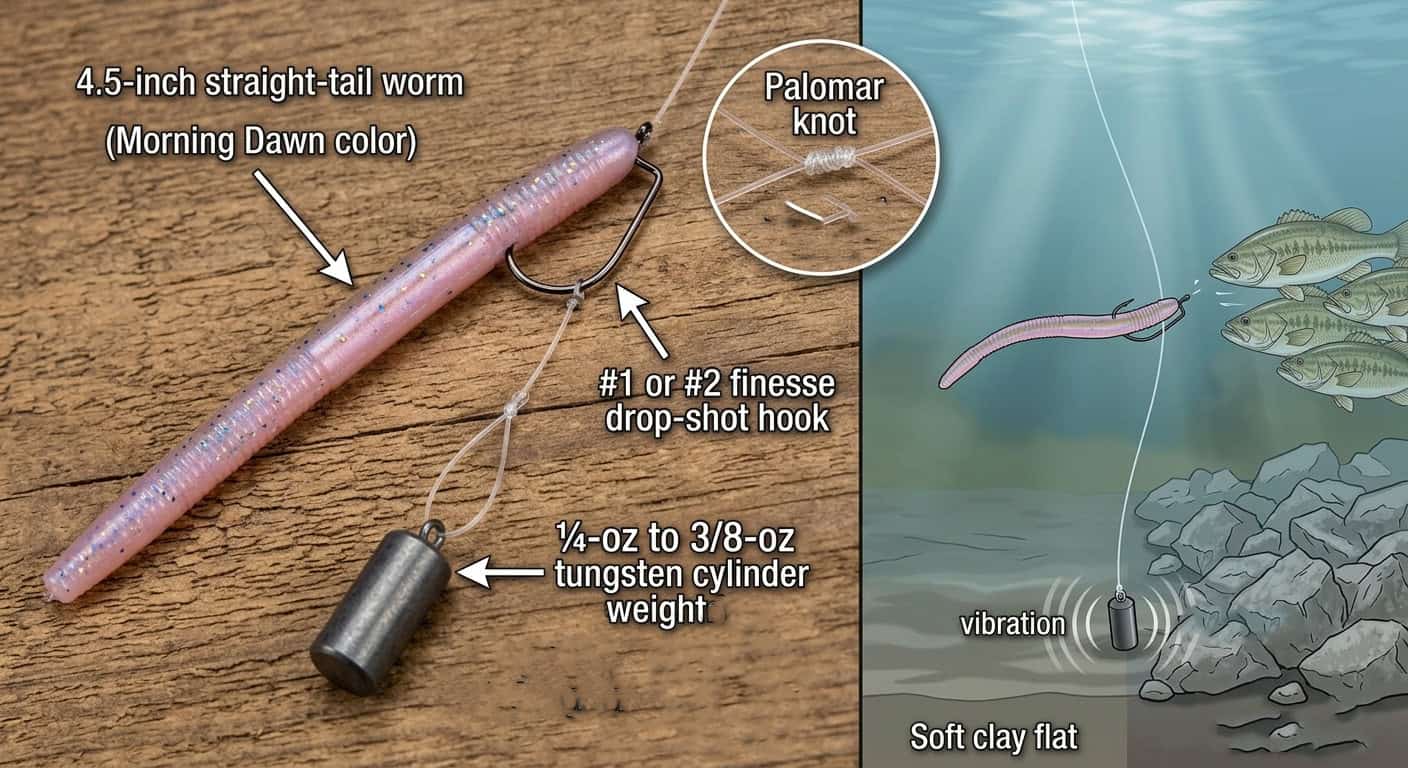
Plastic: A 4.5-inch straight-tail worm. Colors like Morning Dawn or Aaron’s Magic work best in the light-penetrated depths.
The Rig: A #1 or #2 finesse drop-shot hook tied with a Palomar knot. Use a ¼-oz to 3/8-oz tungsten cylinder weight. Tungsten is denser than lead and vibrates differently against the bottom, so you can distinguish between a soft clay flat and a hard rock pile.
Other Species in Lake Allatoona
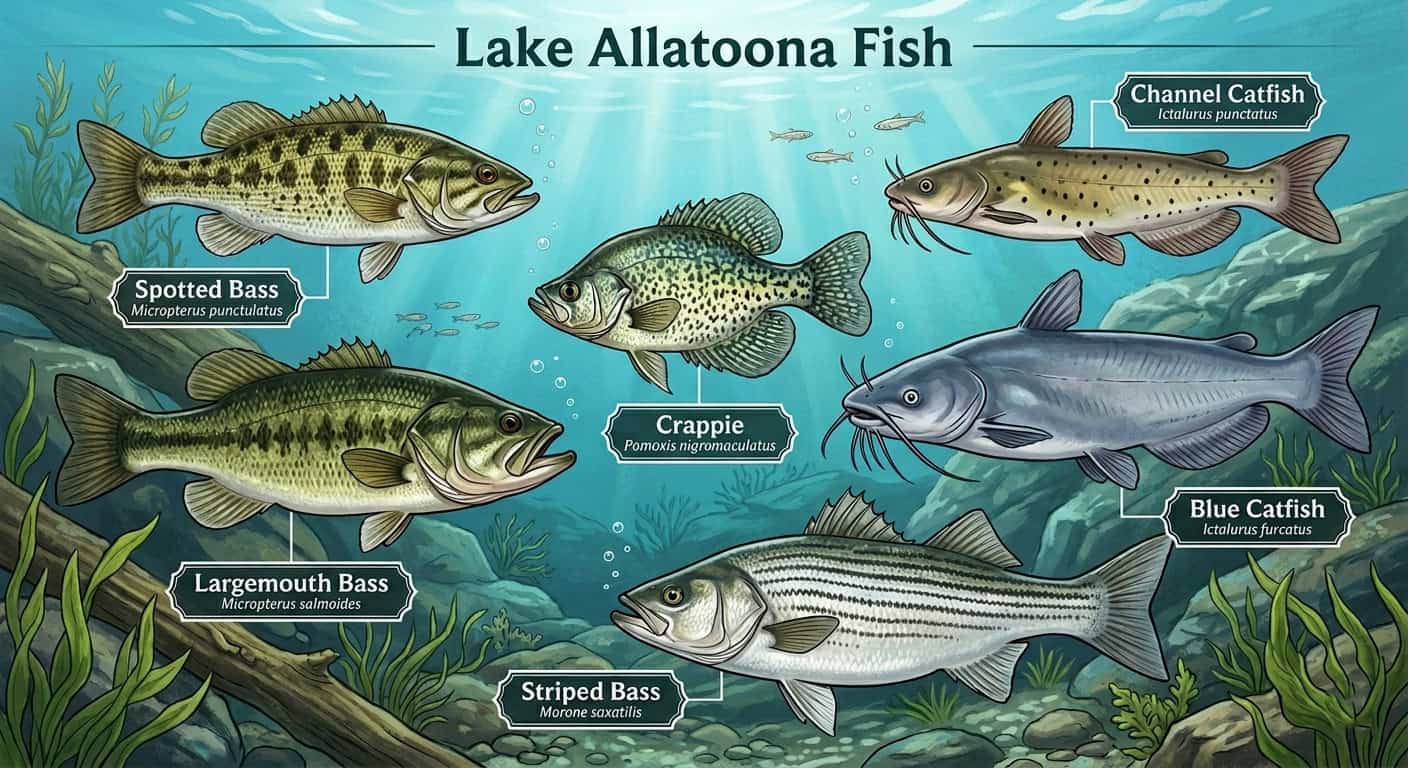
While spots are often the primary draw, Lake Allatoona’s diverse habitat supports a multi-species roster for those willing to adjust their depth. As the summer sun pushes the thermocline deeper, the lake’s population of hybrid and striped bass begin to school over open water. These fish are light-sensitive and oxygen-dependent, often congregating in the cooler, oxygenated water near the dam or following bait into the main channel. For the bait fisherman, use live gizzard shad or threadfin herring suspended at 30 feet. When a school of 10-pound hybrids decides to feed, it isn’t a subtle affair.
Closer to the submerged timber and the fish attractors installed by the DNR, crappie and catfish provide a more stationary but equally rewarding pursuit. Summer crappie move off the spring brush and hold tight to deep structure in 15 to 20 feet of water, requiring the precision of a vertical jig. Meanwhile, in the murky depths of the old river channel, blue and channel cats thrive on the bottom.
Lake Allatoona truly does have something for everyone, be it a testy school of spots or an evening floating in an inner tube.
Work Boots on the Ground Project Highlight
Lake Allatoona Floating Dock & Access Improvement (2024)
With millions of annual visitors to Lake Allatoona, public access is a priority. Access in large reservoirs is frequently compromised by water-level fluctuations, which can vary significantly with seasonal power demand and flood-control requirements. In 2024, the Union Sportsmen’s Alliance (USA) partnered with the Army Corps of Engineers (USACE) to address infrastructure degradation at a high-traffic access point on Lake Allatoona.
The project involved a collaborative effort between 31 union volunteers from SMART Local 85 (Sheet Metal, Air, Rail, and Transportation Workers) and IBEW Local 613 (International Brotherhood of Electrical Workers). These volunteers contributed over 400 hours of professional, specialized labor to replace non-functional infrastructure.
The primary task was the fabrication and installation of a 55-foot articulated aluminum gangway attached to a new floating dock system. Because the gangway is designed to pivot, the dock remains level and accessible even as the reservoir’s water level rises and falls. This infrastructure project ensures that anglers and other recreational users retain safe, stable access to the water, regardless of the lake’s operational level. By utilizing the professional skills of the local union workforce, the project met the engineering standards required for USACE property while maintaining public accessibility.
In all, union volunteers donated 392 hours of labor, valued at more than $20,000, and world-renowned floating dock manufacturer AccuDock was chosen to build the floating dock and gangway as part of a partnership with the USA. The new AccuDock system was entirely funded by the USA’s annual Greater Atlanta Conservation Dinner. Through auctions and raffles held during the dinner, union affiliates and union members donate money that is reinvested in the community through local conservation projects and events.
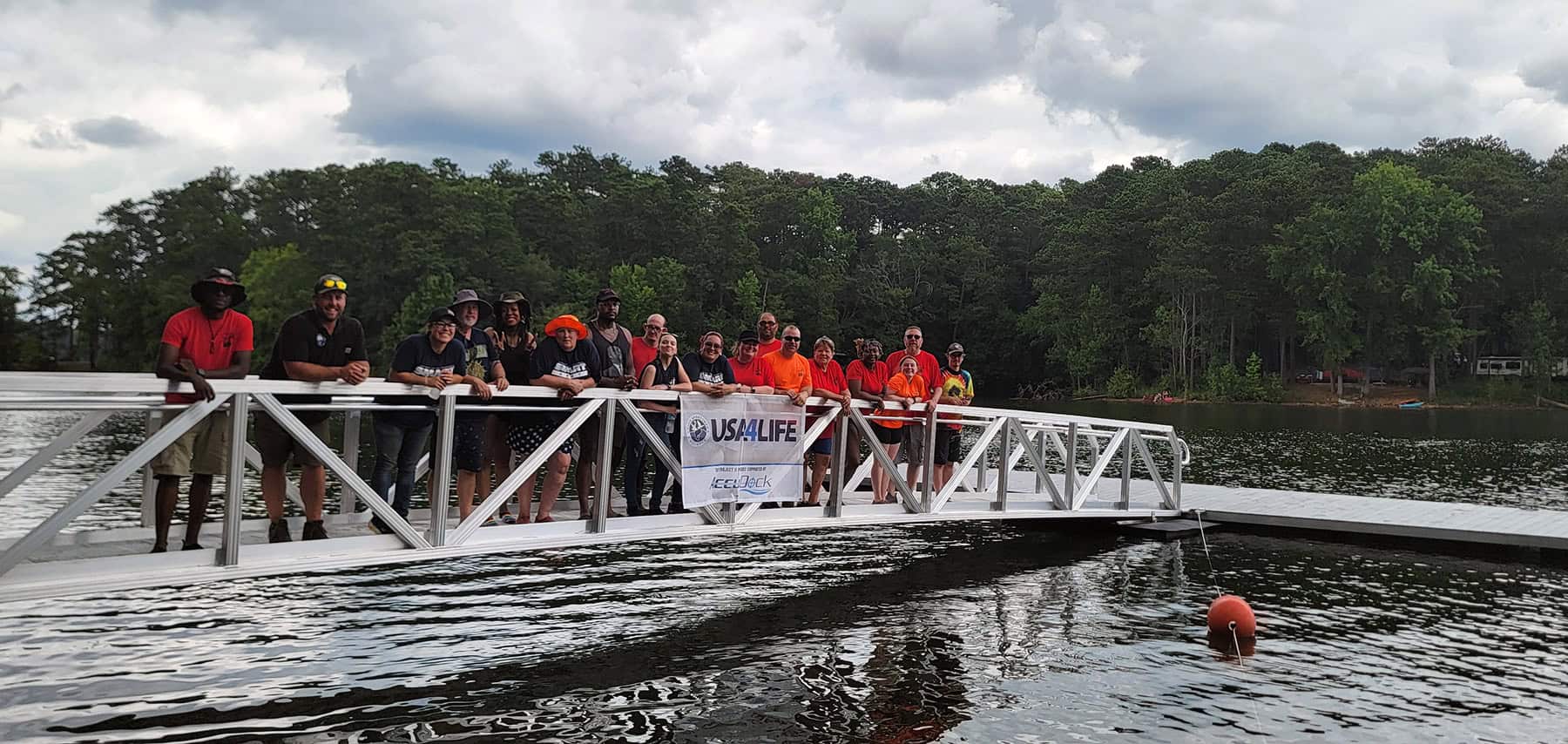
Union volunteers install an AccuDock on Lake Allatoona in 2024.
PJ DelHomme writes and edits content in western Montana. He runs Crazy Canyon Media and Crazy Canyon Journal.
This article was made possible by Union Plus.